NMVTIS Data for Salvage Title Verification

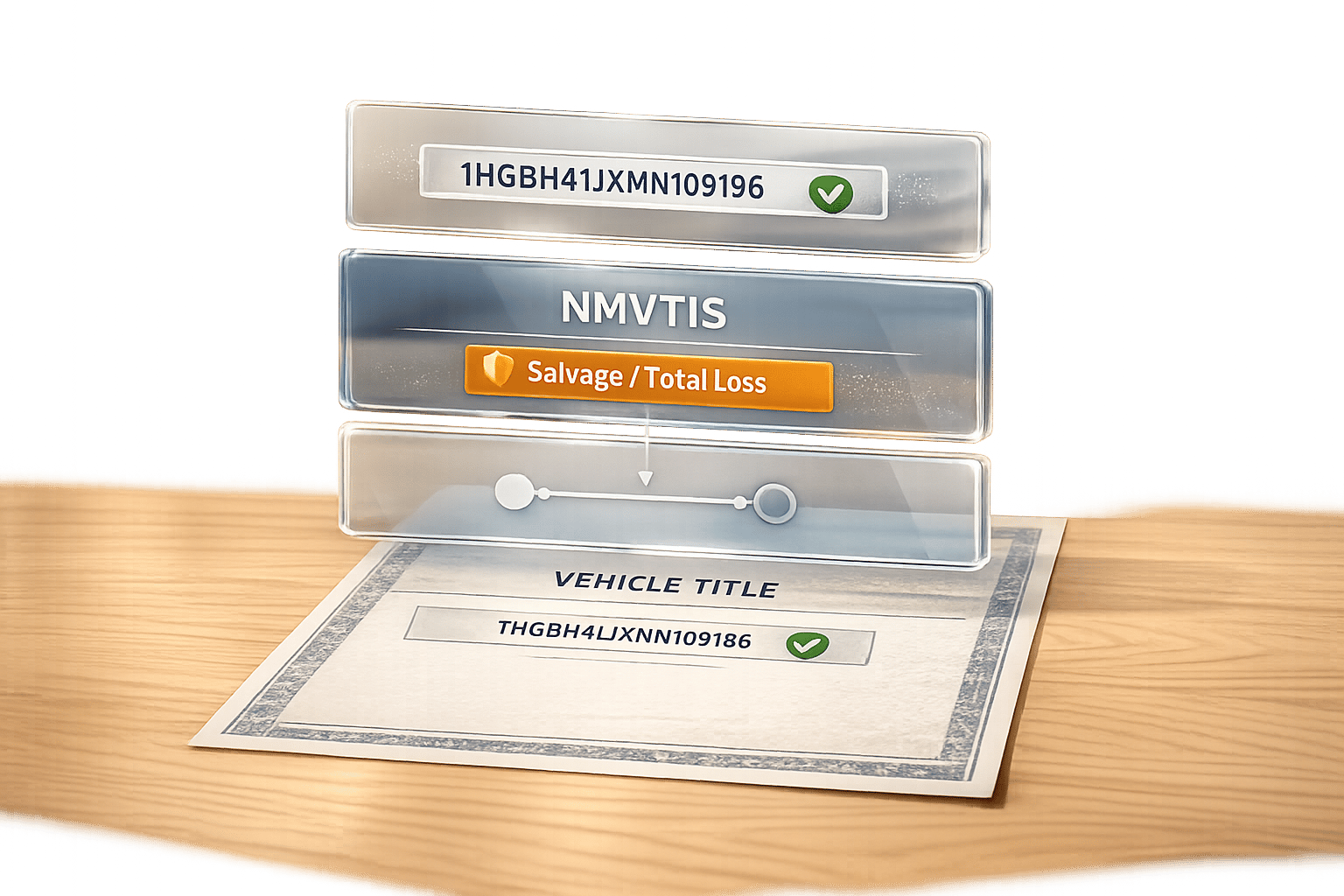
NMVTIS Data for Salvage Title Verification
NMVTIS (National Motor Vehicle Title Information System) is a federally mandated database designed to provide accurate vehicle history, specifically focusing on salvage and total loss vehicles. Managed by the Department of Justice and operated by AAMVA, it pulls data from state DMVs, insurance companies, and salvage yards. This system is key for preventing fraud like title washing, where damaged vehicles are rebranded as clean.
Key Takeaways:
- Salvage Titles: Issued when a vehicle's repair costs exceed its value due to accidents, floods, or fires.
- Data Sources: Includes title brands, insurance total loss flags, and odometer readings, ensuring transparency.
- Business Use: Essential for dealerships, insurers, lenders, and auction platforms to reduce risk and comply with federal requirements.
- API Integration: Services like CarsXE provide real-time access to NMVTIS data for efficient verification.
NMVTIS helps buyers and businesses make informed decisions by identifying vehicles with hidden damage histories. While it's a reliable first step, additional checks may be needed for complete assurance.
Check NMVTIS Before You Buy! - Updated - Closed Captioned
sbb-itb-9525efd
Key NMVTIS Data Fields for Salvage Title Verification
NMVTIS data, sourced federally from state DMVs, insurance carriers, and salvage yards, holds considerable legal importance. Let’s break down the key fields and why they matter.
Title and Brand History
One of the most telling pieces of any NMVTIS report is the title brand. These brands are permanent labels added to a vehicle's title by state DMVs and remain with the vehicle, even if it crosses state lines. Common brands include salvage, junk, flood, fire, and rebuilt, each reflecting a specific type of damage or status that can impact the vehicle's roadworthiness, insurance eligibility, and resale value.
The issue date and originating state tied to each brand provide a timeline of ownership. This timeline is essential for uncovering title washing - a deceptive practice where branding inconsistencies across states are used to hide a vehicle's damage history.
Insurance Total Loss and Salvage Indicators
Another critical NMVTIS field is the insurance total loss flag. Since March 31, 2009, federal law has required insurance carriers to report total loss declarations to NMVTIS. This means a vehicle might show a clean title on paper while already being flagged as a total loss in the database, often before the state has officially branded the title.
Understanding the difference between an insurance total loss and a state salvage brand is key:
Indicator Reported By What It Means Road Legal? Total Loss Insurance Carriers Repair costs exceeded vehicle value Depends on state branding Salvage Brand State DMV Severe damage (~75% of value) legally branded No, until rebuilt and inspected Junk / Non-Repairable State / Recyclers Beyond repair; only usable for parts or scrap Never Flood / Fire State / Insurance Severe damage from specific causes Requires inspection if salvage-branded
"When a vehicle has been deemed a total loss, generally the vehicle has had severe damage. Knowing whether a vehicle has been declared a total loss helps consumers avoid purchasing a potentially unsafe vehicle." - Official NMVTIS Website
This information can protect buyers from unknowingly purchasing vehicles with hidden safety issues.
Odometer Data and Risk Signals
NMVTIS also records the odometer reading each time a vehicle is retitled, creating a reliable mileage history. For example, if a vehicle shows 80,000 miles during one title transfer but 55,000 miles at the next, this discrepancy points to odometer rollback fraud - a tactic often linked with fraudulent salvage repairs.
Odometer data becomes even more revealing when paired with title history. A vehicle that changes hands frequently over a short period, especially across state lines, combined with irregular mileage readings, raises red flags and warrants further investigation.
Business Use Cases for NMVTIS-Based Salvage Verification
As the only federally mandated national repository for vehicle title data, NMVTIS provides critical insights across various industries. Below are examples of how businesses use this trusted resource to protect their operations and reduce risk. Let’s dive into how dealerships, online marketplaces, insurers, financiers, and others utilize NMVTIS for smarter decision-making.
Dealerships and Online Marketplaces
Dealerships depend on NMVTIS for verifying trade-ins. Even when a vehicle’s paperwork looks flawless, it might carry a federal record of total loss. Without checking NMVTIS, dealers risk overpaying for such vehicles and dealing with expensive disputes later.
For online marketplaces, NMVTIS plays a key role in preventing title washing by tracking branding history across the country. This ensures that salvage or junk designations don’t vanish when vehicles cross state lines. It’s also a powerful tool against VIN cloning, a scam where criminals use a legitimate VIN from a salvage vehicle on a stolen car. Running a real-time NMVTIS query can quickly identify mismatches and stop fraudulent listings before they go live.
"NMVTIS is effective in greatly reducing (if not eliminating) this type of fraud, preventing a significant number of crimes, and potentially saving the lives of consumers who might otherwise and unknowingly purchase unsafe vehicles." - U.S. Department of Justice
Accurate salvage verification is equally important for insurers and financiers, helping them assess risk and value more effectively.
Insurance and Finance Companies
Insurers and lenders rely on NMVTIS as a reliable and up-to-date source of vehicle title information. Vehicles with salvage titles are typically worth 20% to 40% less than their clean-titled counterparts. Since NMVTIS records total loss declarations before state DMVs officially brand titles, it allows for a more precise valuation of a vehicle’s true worth. For lenders, depending solely on paper titles can lead to financing high-risk assets, while major insurers often restrict salvage vehicles to liability-only policies.
Fleet Operators and Auction Houses
Fleet operators and auction houses benefit from NMVTIS’s comprehensive data to minimize risks. Fleet managers can thoroughly vet potential acquisitions, ensuring transparency regarding total loss or salvage history. This reduces the chance of regulatory issues tied to purchasing branded vehicles. Auction houses also use NMVTIS to guard against VIN cloning and ensure the vehicles they sell meet disclosure requirements.
"NMVTIS serves as a repository of information on salvage vehicles... to ensure that salvage vehicles, including those vehicles determined to be a total loss by insurance carriers, are bought and sold with full disclosure." - NMVTIS
These diverse use cases highlight the importance of integrating NMVTIS into modern automotive operations through seamless API solutions.
How to Integrate NMVTIS Data Technically
To integrate NMVTIS data, you’ll need to work with approved providers that offer REST APIs. These providers compile data from sources like state DMVs, insurance companies, and salvage yards, delivering the information in a structured format that can be seamlessly used in your applications. This integration ensures accurate salvage title verification for both business and developer needs.
How NMVTIS Data Is Accessed
At the core of NMVTIS integration is its extensive data repository. To access this data programmatically, each query starts with a 17-digit VIN. Approved providers make this process straightforward by enabling HTTP GET requests that return structured JSON responses. Since the data is sourced from a live, federally mandated system, it reflects the most up-to-date title statuses - not outdated snapshots.
Common API Integration Patterns
The integration process is relatively simple. You send a GET request containing the VIN and your API key, and the API responds with a JSON payload. From there, you’ll parse specific fields to assess salvage conditions. Key fields to focus on include brandsInformation, junkAndSalvageInformation, and insuranceInformation.
Within brandsInformation, you’ll find NMVTIS brand codes that help identify potential risks. Here are some of the most critical codes to monitor:
Brand Code Label Meaning 01 Flood Damage Indicates damage caused by freshwater or saltwater 08 Junk Vehicle is only suitable for parts; not safe for operation 09 Rebuilt Previously salvaged but has passed safety inspections 11 Salvage Damage exceeds the state’s threshold (typically 70–100% of the vehicle's value) 31 Totaled Declared a total loss by an insurer or jurisdiction 49 Salvage - Stolen Total loss settlement due to theft
In the junkAndSalvageInformation field, the VehicleDispositionText often contains insights like "SOLD" from reporting entities such as Copart, Inc. or IAA. This data can even appear before the state DMV officially brands the title, offering a critical advantage for early verification.
To simplify implementation, official SDKs (e.g., for Node.js) handle requests, error management, and JSON parsing. These tools, combined with providers like CarsXE, make real-time salvage verification accessible and efficient.
Using CarsXE APIs for Salvage Verification
CarsXE offers a direct connection to NMVTIS vehicle history through its https://api.carsxe.com/history endpoint. The API delivers data on salvage records, title brands, insurance total loss information, and odometer history, with response times averaging under 120ms - fast enough for real-time needs like onboarding vehicles or live auction scenarios. CarsXE operates on a pay-only-if-history-exists model, which helps reduce costs when querying vehicles with no prior history.
Additionally, CarsXE supports Zapier integrations, allowing users to connect with over 8,000 tools such as CRMs, Google Sheets, and Airtable - all without requiring custom code. With a database covering over 275 million vehicle records across 50+ countries, it’s especially helpful for verifying imported vehicles where NMVTIS data might be incomplete.
"The API is super easy to integrate and the data quality is consistently excellent. We've reduced our vehicle onboarding time by 70% since switching to CarsXE." - Senior Director of Software, Major Parking App
Compliance and Risk Management with NMVTIS Data
API-Based NMVTIS Verification vs. Manual Title Checks
Federal Requirements and NMVTIS Reporting
The Anti-Car Theft Act mandates NMVTIS reporting at the federal level. Three main groups are required to comply: state motor vehicle titling agencies, insurance carriers (including self-insured entities), and auto recyclers, junkyards, and salvage yards. These entities have been obligated to provide monthly reports since March 31, 2009.
Each report must include key details such as the VIN, the date the vehicle was designated as salvage, and its current ownership. Insurance carriers are also required to report any vehicle declared a total loss - even if the owner decides to retain the vehicle without retitling it. To fulfill these requirements, reports are submitted through Department of Justice-approved third-party data consolidators, including AAMVA, Auto Data Direct (ADD), and ISO. However, junk or salvage yards that handle fewer than five salvage vehicles annually are exempt from this requirement.
These federal regulations ensure the availability of detailed data, but NMVTIS information isn't static - it can change over time.
Handling Incomplete or Changing Data
NMVTIS data isn't set in stone. For example, a vehicle initially listed as "held for parts" might later be updated to "crushed." Federal guidelines require salvage yards to submit updated reports within 30 days of any status change.
"Junk and salvage yards are responsible for ensuring the accuracy and completeness of their reporting and for providing corrected information to the system, should the disposition be changed from what was initially reported." - U.S. Department of Justice
This variability means businesses acquiring vehicles should be cautious. A single query at the time of purchase might not reflect later updates. It's often wise to recheck NMVTIS data closer to the transaction date, particularly for vehicles sourced from salvage auctions. Additionally, since smaller operators are exempt from reporting, gaps in NMVTIS records don't always signify a clean history - they could point to an unreported event. Cross-referencing NMVTIS data with state DMV records can help address these gaps.
Given the potential for changes and incomplete data, real-time API-based verification is becoming increasingly important.
API-Based Verification vs. Manual Title Checks
Manual title checks are time-consuming, prone to errors, and often lag behind real-time updates. API-based verification solves these issues by providing instant access to federally mandated data. An API query delivers structured, machine-readable results with risk indicators, removing the need for manual interpretation.
This real-time functionality is particularly beneficial in high-volume environments, where manually reviewing paper titles is impractical. API responses are returned in milliseconds, while manual, cross-state title checks can take days.
Method Speed Accuracy Scalability Fraud Resistance API-Based (NMVTIS) Real-time Low Risk High High Manual Title Check Days High Risk Low Low
For businesses handling a significant number of vehicles, relying on manual checks can increase both legal and financial risks. API-based NMVTIS verification not only streamlines the process but also enhances compliance efforts. This makes NMVTIS an indispensable tool for reliable and secure salvage title verification.
Conclusion: Using NMVTIS and CarsXE to Simplify Salvage Verification
NMVTIS serves as the go-to federal resource for title brand history, total-loss records, and salvage indicators in the U.S. It effectively addresses gaps left by traditional methods, helping to combat fraud schemes like title washing that state-level DMV checks often miss.
This wealth of data directly impacts businesses by cutting costs and reducing risks. Identifying salvage or junk brands early can prevent overpaying for vehicles, avoid risky financing, and sidestep unexpected legal or repair expenses. To put things into perspective, the National Highway Traffic Safety Administration reports that over 450,000 vehicles may be totaled by flood damage in some years, with many re-entering the market under murky circumstances. Given the scale of this issue, automated and systematic checks are no longer optional - they’re essential.
CarsXE provides a straightforward way to integrate NMVTIS data into your operations. Its Vehicle History API delivers structured JSON responses, covering salvage, junk, rebuilt, and flood brand codes, as well as insurance total-loss records and odometer data. This allows businesses to embed these checks seamlessly into inventory intake processes, loan workflows, or auction tools using standard HTTPS and RESTful integration. Beyond salvage data, CarsXE’s API suite also includes market values, recall information, and vehicle specs - all in one response - helping businesses make informed decisions about both risk and pricing.
However, it’s worth noting that while NMVTIS data is dependable, it has its limitations. Updates can lag, and some smaller operators are not required to report. For this reason, NMVTIS data should be treated as a first-line screening tool. Cases with unclear or high-value stakes may still need further investigation, such as direct state title checks or physical inspections. Additionally, logging each API response creates an audit trail that can be invaluable for compliance and dispute resolution.
For high-volume operations, integrating NMVTIS through CarsXE transforms salvage verification into a streamlined, automated process. This not only minimizes disputes and supports regulatory compliance but also strengthens buyer confidence - something that, once lost, is tough to regain.
FAQs
Can a car have a clean title but still be a total loss in NMVTIS?
Yes, a car can have a clean title but still be listed as a total loss in the NMVTIS (National Motor Vehicle Title Information System). This situation can occur for several reasons, such as delays in reporting, title washing (a fraudulent practice to hide a vehicle's salvage status), or when an insurance company declares the vehicle a total loss, but the title has not yet been updated to reflect a salvage status. To avoid surprises, always check the vehicle’s history using trustworthy data sources to get a complete picture.
What NMVTIS fields are the biggest red flags for title washing or VIN fraud?
Key warning signs in NMVTIS fields that may point to title washing or VIN fraud include brands like salvage, rebuilt, flood, fire, junk, or non-repairable. Other red flags to watch for are total loss records from insurance companies, salvage auction entries, and instances of multiple quick cross-state registrations. These clues can reveal vehicles with potentially concealed or questionable histories.
When should I recheck NMVTIS data before buying, lending, or auctioning a vehicle?
Before you buy, lend on, or auction a vehicle, make sure to double-check the NMVTIS data. This step helps confirm whether the vehicle currently has a salvage or total loss status. It's a simple way to protect yourself from fraud, especially in cases involving title washing or recent re-titling. Verifying this information ensures you're making decisions based on accurate, up-to-date details, helping you avoid unnecessary risks.
Related Blog Posts
- Vehicle History API: Common Questions Answered
- How VIN Decoding Reveals Flood Damage
- Top 7 APIs for Accident History Reports
- How VIN Decoding Powers Compliance Verification