How VIN Decoding Helps with Import Compliance

How VIN Decoding Helps with Import Compliance
Importing vehicles into the U.S. requires strict adherence to regulations set by agencies like the DOT, EPA, and CBP. Missing even one requirement can lead to fines, delays, or denied entry.
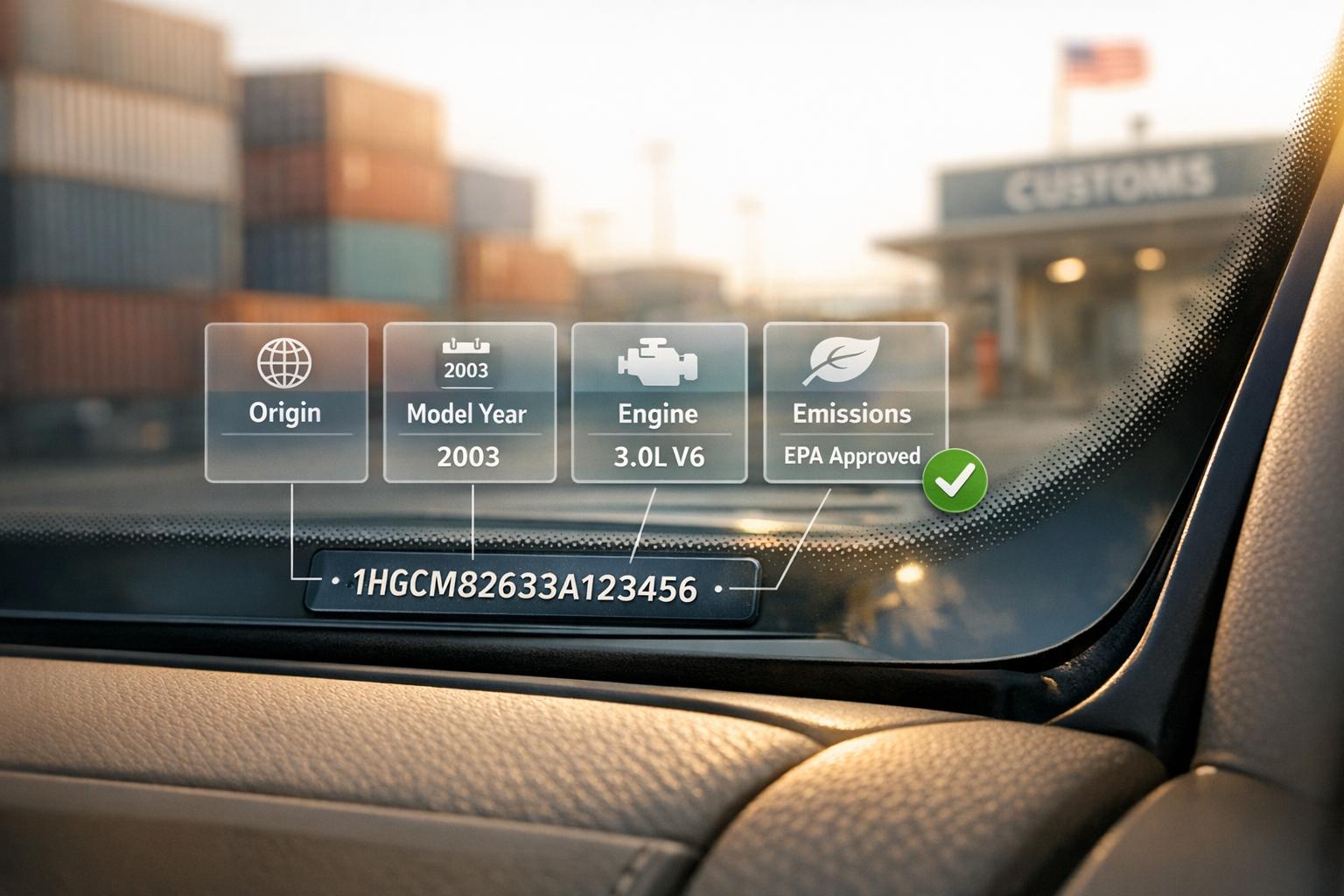
VIN decoding simplifies this process by extracting critical vehicle details - like origin, model year, and emissions compliance - from the 17-character Vehicle Identification Number. This ensures accurate data for customs forms, duty rates, and safety/emission checks.
Key Takeaways:
- What is VIN Decoding? It translates a vehicle's VIN into structured data, such as engine type, emission standards, and production year.
- Why is it Important? Helps ensure compliance with safety (FMVSS), emissions (EPA), and customs (CBP) regulations.
- Who Needs It? Importers, especially those handling non-U.S. vehicles or large-scale shipments.
By automating VIN decoding with tools like CarsXE, importers can reduce errors, speed up compliance checks, and avoid costly delays.
Is Your Car U.S. Compliant? Check This Before Importing
sbb-itb-9525efd
Key U.S. Regulations That Rely on VIN Data
When it comes to ensuring compliance with U.S. import regulations, accurate VIN decoding plays a critical role. Three federal agencies oversee vehicle imports at the border: NHTSA (under the DOT), the EPA, and CBP. Each one relies heavily on VIN data to enforce their respective rules. Missteps in decoding can lead to costly delays and complications. Here's why precise VIN decoding is so important.
DOT and NHTSA Safety Standards
The National Highway Traffic Safety Administration (NHTSA) requires importers to submit DOT Form HS-7, which determines whether a vehicle complies with Federal Motor Vehicle Safety Standards (FMVSS). The VIN provides key details like the vehicle's manufacture date, country of origin, and whether it was built to meet U.S. standards.
If the VIN indicates the vehicle wasn’t built for the U.S. market and lacks a certification label, it is classified as "nonconforming." In such cases, the importer must post a bond equal to 1.5 times the vehicle's dutiable value and work with a DOT-Registered Importer (RI) to bring the vehicle into compliance. This can be an expensive and time-consuming process, which is why decoding the VIN beforehand is so important.
"Any person knowingly making a false declaration is subject to a fine of not more than $10,000 or imprisonment for not more than 5 years or both." - NHTSA
The risks are high, but decoding the VIN early on provides clarity about the vehicle’s compliance status.
EPA Emissions Standards
The Environmental Protection Agency (EPA) focuses on emissions compliance, which depends on a vehicle's manufacturing date and engine type - both of which are revealed through VIN decoding. For instance, gasoline-powered vehicles made after December 31, 1967, must meet federal emissions standards, while diesel vehicles face a similar requirement starting December 31, 1974.
Here’s a quick reference for EPA compliance dates:
Vehicle Category EPA Standard Applies If Manufactured After Gasoline-fueled cars December 31, 1967 Heavy-duty engines December 31, 1969 Diesel-fueled cars December 31, 1974 Diesel-fueled light-duty trucks December 31, 1975 Motorcycles (>49cc) December 31, 1977
Importers must file EPA Form 3520-1 for passenger vehicles or Form 3520-21 for heavy-duty engines. These forms rely on VIN data to verify the engine type and emissions certification. If the vehicle isn’t EPA-certified and doesn’t qualify for the 21-year exemption, modifications must be handled by an Independent Commercial Importer (ICI) - adding significant costs and delays.
"The Clean Air Act prohibits importation into the United States of any motor vehicle, motor vehicle engine, nonroad engine and equipment that does not conform to the EPA emission standards and requirements." - EPA
While the EPA focuses on emissions compliance, CBP uses VIN data to manage the financial and classification aspects of imports.
CBP and Customs Requirements
The Customs and Border Protection (CBP) agency relies on VIN decoding for financial and classification purposes, including duty rates, tariff classification, and trade agreement eligibility. For example, the first character of a VIN identifies the country of manufacture, which CBP uses to determine if the vehicle qualifies for duty-free treatment under the USMCA (for vehicles from Canada or Mexico).
Accurate classification is critical. Misclassifying a vehicle as a light-duty truck instead of a passenger car can result in a 25% duty rate rather than 2.5%. That’s a massive difference - on a $40,000 vehicle, it’s the difference between paying $1,000 and $10,000 in duties. CBP also uses VIN data to complete CBP Form 7501 (Entry Summary), which must be filed electronically through the Automated Commercial Environment (ACE) system.
Additionally, CBP may impose a Gas Guzzler tax on vehicles with a combined fuel-economy rating below 22.5 miles per gallon. This is yet another data point derived from the VIN. Errors in classification don’t just lead to delays - they can result in the vehicle being seized at the port.
How to Prepare a VIN for Decoding
Before decoding a VIN, ensure it's complete and accurate. Even a small error, like a transposed character, can lead to incorrect data and issues with agencies like the NHTSA, EPA, or CBP.
Where to Find the VIN
The VIN can typically be found in several locations on a vehicle, including:
- The lower corner of the driver's side windshield
- The door jamb on the driver’s side
- Under the hood near the latch
- Along the front frame
If physical inspection isn't an option, you can check documents like the title, registration, insurance card, or the original window sticker. For large-scale operations, VINs can also be retrieved digitally via the OBD-II port or scanned optically using a barcode scanner or smartphone app.
Checking VIN Accuracy
Vehicles manufactured after 1981 follow a standardized 17-character VIN format. These VINs only use capital letters and digits, and the letters I, O, and Q are excluded to avoid confusion with the numbers 1, 0, and 9.
The 9th character in the VIN serves as a "check digit", which is verified using a MOD 11 formula. Here's how it works:
- Assign numerical values to each letter.
- Multiply each value by its positional weight.
- Divide the sum by 11.
If the remainder is 10, the check digit should be "X." Otherwise, it must match the calculated value. A mismatch could indicate either an input error or possible tampering.
"A match [of the check digit] does not prove the VIN is correct, because there is still a 1/11 chance that any two distinct VINs have a matching check digit." - Wikipedia
Always cross-check the VIN on the vehicle's dashboard with the one on the title, registration, and window sticker. Any differences between these sources are warning signs that need further investigation before proceeding with import documentation.
Once you've confirmed the VIN follows the standard format, address any variations that may appear in older or specialty vehicles.
Handling Non-Standard VINs
Vehicles produced before 1981 use VINs that range from 5 to 14 characters, without a standardized format. As one writer explains:
"Before 1981, reading a VIN was like trying to read handwriting in the dark. Because there was no standardized format." - Adewale Peter, Content Writer, InstantVINReports
Decoding these older VINs often requires specialized tools designed for classic vehicles. For instance, low-volume manufacturers use "9" as the third character of the WMI, with positions 12 through 14 providing additional manufacturer details. Importers handling niche or specialty vehicles should pay attention to these patterns.
Modern electric vehicles may also deviate from traditional VIN structures. Some use positions within the VDS to indicate battery capacity instead of engine displacement, which can influence how compliance data is interpreted.
Using VIN Decoding to Check Compliance
Once you've confirmed a VIN's validity, the next step is decoding it. This process reveals critical details about the vehicle's identity and technical specs that align with NHTSA, EPA, and CBP regulations. These insights form the backbone of compliance checks and help streamline import processing.
Reading Safety and Emissions Data from a VIN
Each segment of a VIN holds specific compliance-related details. Here's an overview of what you can learn:
VIN Segment Positions Key Compliance Data WMI 1–3 Manufacturer identity, country of origin, NHTSA registration VDS 4–9 Body type, engine, restraint systems, check digit VIS (model year) 10 Age determination for 25-year rule; applicable FMVSS/EPA tier
For emissions, decoding the VIN reveals the engine type, fuel system, and emission standards the vehicle meets. For U.S. imports, look for standards like LEV, ULEV, or SULEV. If the VIN shows compliance with only Euro-tier standards (e.g., Euro 5 or Euro 6), the vehicle might not meet U.S. certification requirements. In such cases, a Registered Importer (RI) and modifications could be necessary to ensure legal entry into the country.
For handling large volumes of vehicles, automation is key.
Automating Compliance Checks with APIs
Manually checking VINs isn't practical for high-volume operations. A VIN decoding API simplifies the process by enabling batch submissions and delivering standardized data - including year, make, model, engine type, and fuel type - in a matter of seconds.
CarsXE's VIN Decoder API processes requests in under 120ms and supports vehicles from over 50 countries, making it a valuable tool for managing imports from multiple markets. Automated workflows can flag vehicles that don't match U.S. configurations or route specific cases, like diesel vehicles from post-2007 model years, into dedicated emissions review queues. One parking app's senior software director shared:
"We've reduced our vehicle onboarding time by 70% since switching to CarsXE."
This level of efficiency is crucial when dealing with tight customs deadlines and large shipments.
What Decoded VIN Data Can Do in Practice
Decoded VIN data plays a pivotal role throughout the import process. Before shipping, you can use it to run a recall check via NHTSA's lookup tool. Between 2010 and 2019, over 280 million vehicles were recalled in the U.S., many with multiple recalls. An unresolved recall can lead to registration issues in certain states and complicate the compliance documents required for CBP.
VIN decoding also ensures that the physical vehicle matches its documentation. By cross-referencing decoded data with forms like CBP Form 7501 and EPA Form 3520-1, you can catch discrepancies - such as mismatched body style, engine, or model year - and address them before customs clearance. Resolving these issues upfront prevents delays and ensures smoother processing.
Building a VIN-Based Import Compliance Workflow
VIN-Based Import Compliance Workflow: Capture, Decode, Verify & Document
Steps for an Efficient Workflow
Creating a smooth compliance workflow involves four key stages: capture, decode, verify, and document. Skipping any of these steps can lead to compliance issues during customs checks or audits.
Manual entry of VINs can lead to errors, often caused by typos. To avoid this, using VIN OCR (Optical Character Recognition) technology can directly extract VINs, speeding up the intake process - especially crucial for handling large volumes.
After capturing and validating the VIN, the decoding process provides essential details like emission standards, engine specifications, fuel type, production country, and vehicle weight. The verify stage ensures this data aligns with NHTSA recall records, title status, and accident history. Finally, the document stage organizes all the information into structured records for audits and regulatory filings.
For even greater efficiency, integrating specialized APIs can automate and streamline each stage of this process.
Using CarsXE APIs in Your Workflow
CarsXE offers a suite of APIs designed to support each step of the compliance workflow. Here's how their tools align with the workflow stages and the data they provide:
Workflow Stage CarsXE API/Tool Key Data Points Capture VIN OCR / Plate Decoder VIN, license plate number Decode International VIN Decoder Plant country, emission standards, engine specs, CO2 emissions Verify History & Recall APIs NHTSA recalls, accident history, title status Document Dashboard / Export Structured JSON/CSV for audit logs
The International VIN Decoder is particularly useful for non-U.S. imports, covering vehicles from over 50 countries and providing up to 40 attributes, such as CO2 emissions and plant location. This data is essential for meeting EPA and CBP filing requirements. Impressively, the decoder covers 99.31% of vehicles in Europe and 98.46% in North America.
For large-scale import operations, the Recalls Batch API enables simultaneous safety checks for multiple vehicles. API responses are delivered in JSON format within approximately 120ms, making it feasible to perform real-time compliance checks within existing customs brokerage or ERP systems. By leveraging CarsXE's API tools, you can ensure that every stage of the workflow contributes to faster processing and error-free compliance reporting.
"CarsXE offers MotorTango's customers accurate and reliable vehicle data across many makes and models. Their VIN decoder and specs API are second to none." - Andy Liakos, CTO, MotorTango
Organizing Data for Audits and Reporting
Once the workflow is automated with APIs, the next critical step is structuring the data for easy audits and reporting.
Decoded VIN data is only as effective as the way it’s organized. Each vehicle record should include a full set of decoded attributes along with a timestamp indicating when the compliance check was conducted.
CarsXE’s no-code dashboard simplifies this process by supporting bulk lookups and allowing you to export records in CSV or JSON formats. With a single API key, you can consolidate data from multiple endpoints - such as Specs, History, Recalls, and Market Value - into a unified record for each vehicle. This makes internal reporting and responding to regulatory inquiries much easier.
Storing results with timestamps is especially important, as it provides a snapshot of a vehicle’s compliance status at the time of import. This can be crucial if a recall is announced or regulations change after the vehicle has already cleared customs.
Conclusion
VIN decoding plays a crucial role in streamlining compliance processes for vehicle importers. By converting a 17-character VIN into structured compliance data, it allows for quick and efficient pre-screening of vehicles. This process uncovers critical details like model year, engine type, manufacturing location, and emissions standards - information that would otherwise require tedious manual checks. The result? Fewer errors, faster processing, and a clear audit trail.
That said, VIN decoding should be seen as an initial step. It highlights potential issues early, enabling teams to focus on cases requiring deeper review. Importers must still rely on official verifications from agencies like CBP, NHTSA, and EPA to ensure full compliance.
Next Steps for Importers
To enhance your compliance process, start by integrating VIN decoding at the vehicle intake stage. This helps identify mismatches early, making corrections easier. For a robust solution, consider testing CarsXE's International VIN Decoder. It can retrieve up to 40 attributes, such as CO2 emissions, engine specifications, and manufacturing plant location, for vehicles from over 50 countries - all in under 120ms. Plus, the free tier (no credit card required) makes it easy to test how it fits into your existing workflow.
Once integrated, combine VIN decoding with recall and history checks to build a comprehensive compliance profile. Keeping timestamped records for each vehicle further strengthens your audit trail, providing clear evidence of due diligence in case of regulatory scrutiny. This layered approach ensures your compliance process is both efficient and thorough.
FAQs
What can VIN decoding tell me before I ship a vehicle to the U.S.?
When you decode a VIN, you unlock crucial details about a vehicle, like its manufacturer, model year, engine specifications, and whether it complies with U.S. safety and emissions standards. This information is essential for verifying the vehicle's eligibility and ensuring it meets import regulations before shipping.
Does VIN decoding prove a vehicle is DOT and EPA compliant?
VIN decoding reveals crucial details about a vehicle, such as its manufacturer, model, production year, and emission standards. However, it doesn’t directly verify if the vehicle meets DOT or EPA regulations. To confirm compliance, you’ll need additional documentation or further inspections.
How do I handle a VIN that isn’t 17 characters?
A VIN that's shorter than 17 characters might still qualify for import under certain NHTSA regulations. However, the majority of vehicles need a 17-character VIN to meet registration and compliance standards. Be sure to review the applicable guidelines to confirm adherence to import and registration rules.
Related Blog Posts
- How VIN Decoding Powers Compliance Verification
- VIN Decoding for Emission Compliance Tracking
- Impact of Regional Standards on VIN APIs
- How VIN Decoding Retrieves Vehicle Specs